Our Bulk Bags: Frequently Asked Questions
Questions about our Bulk Bags? Let's answer some FAQs:
“Are the bags compostable or recyclable?”
Some of our bulk bags are compostable, some are recyclable. Compostable bags will have the Turtle symbol on the back of the bag 🐢, while recyclable bags have the recycle symbol on the back ♻️
*Please note that as of July 2026, we are phasing out the compostable bags to exclusively use recyclable bags. This change is due to customer feedback and the superior durability of the recyclable bags.
“What is Turtle Films?”
We work with Rootree to make our bulk bags, and Turtle Films is the name of their proprietary (but 3rd party tested) compostable material that the bags are made of.
“What are the compostable bags made of?”
The compostable bags (Turtle Films) are made of 98% certified home compostable materials like wood pulp cellulose, starch blend and other non-GMO plant-based renewable materials.
“Do the compostable bags really compost?”
Yes! Several of our staff members have put the compostable bags in their home compost bins and saw them break down. It can take them 8-12 months to fully decompose in a home compost bin.
“Where do I put the compostable bags?”
If you have a home compost bin, that is your best bet. You can place them in your kitchen compost bin collected by the city - however, because they resemble plastic, they may not be properly dealt with at the processing facility and could be sent to the landfill. In end-of-life, this is not much different from conventional flexible packaging, which is not recyclable in most municipalities. This is where the compostable packaging's pre-life cycle truly shines, as it is produced using renewable materials, which means it’s designed to break down faster than other materials without leaving harmful micro-plastics and toxins behind.
“How long can the compostable bags last?”
The compostable bags are designed to perform at their best used within 6 months. It is best stored between 60-75 degrees Fahrenheit at 30-50% relative humidity. Avoid direct sunlight, high humidity, freezing cold, dry ice, and other extreme conditions.
“What are the recyclable bags made of, and how to dispose of them?”
The recyclable bags are made of Polyethylene (FDA approved) and incorporate Post-Consumer recycled and Post-Industrial recycled materials. They are recyclable under Code 2 and can be placed in your blue bin.
Have any more questions? You can read more about Rootree's Compostable Bags here and FAQs, and their Recyclable bags here.
Or feel free to
contact us and we would be happy to answer your questions.
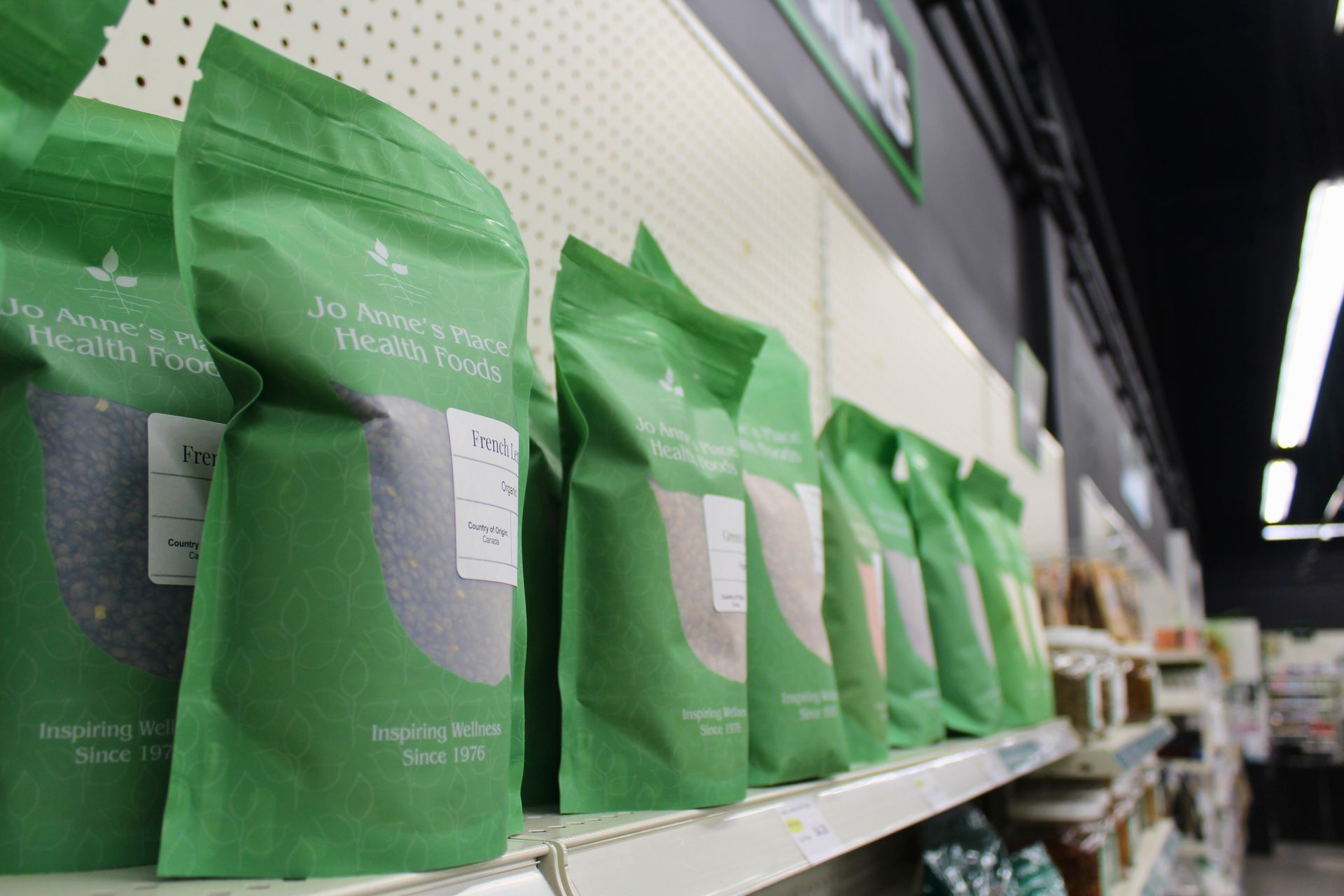
We are proud to partner with Rootree in making our bulk bags. They are a Canadian (Burlington-based) company that is dedicated to creating innovative, sustainable packaging solutions.
Protecting and preserving the Earth is one of our top priorities here at Jo Anne’s Place. It’s even in our Mission Statement: “Inspiring Wellness on Purpose, now and for future generations.” There are no future generations if we don’t take care of our environment!
Sustainable practices within our business include proper recycling, composting, and giving ‘imperfect’, bruised, or slightly off produce to staff members who have livestock or wildlife on their properties! We also offer ‘Produce Seconds’ at a reduced price to customers.
And choosing Certified Organic produce is a major factor. Organic farming plays a huge role in protecting our planet, from keeping waterways clean to preserving soil integrity.
Fair trade is also extremely important to us, because sustainability is about supporting the equity of humans, too.
By sourcing the vast majority (over 80%) of the products on our shelves within Canada, often within Ontario, we help cut down on emissions through transportation.
We are also proud to carry many brands with sustainable practices and products with zero, minimal, recyclable, or reusable packaging.